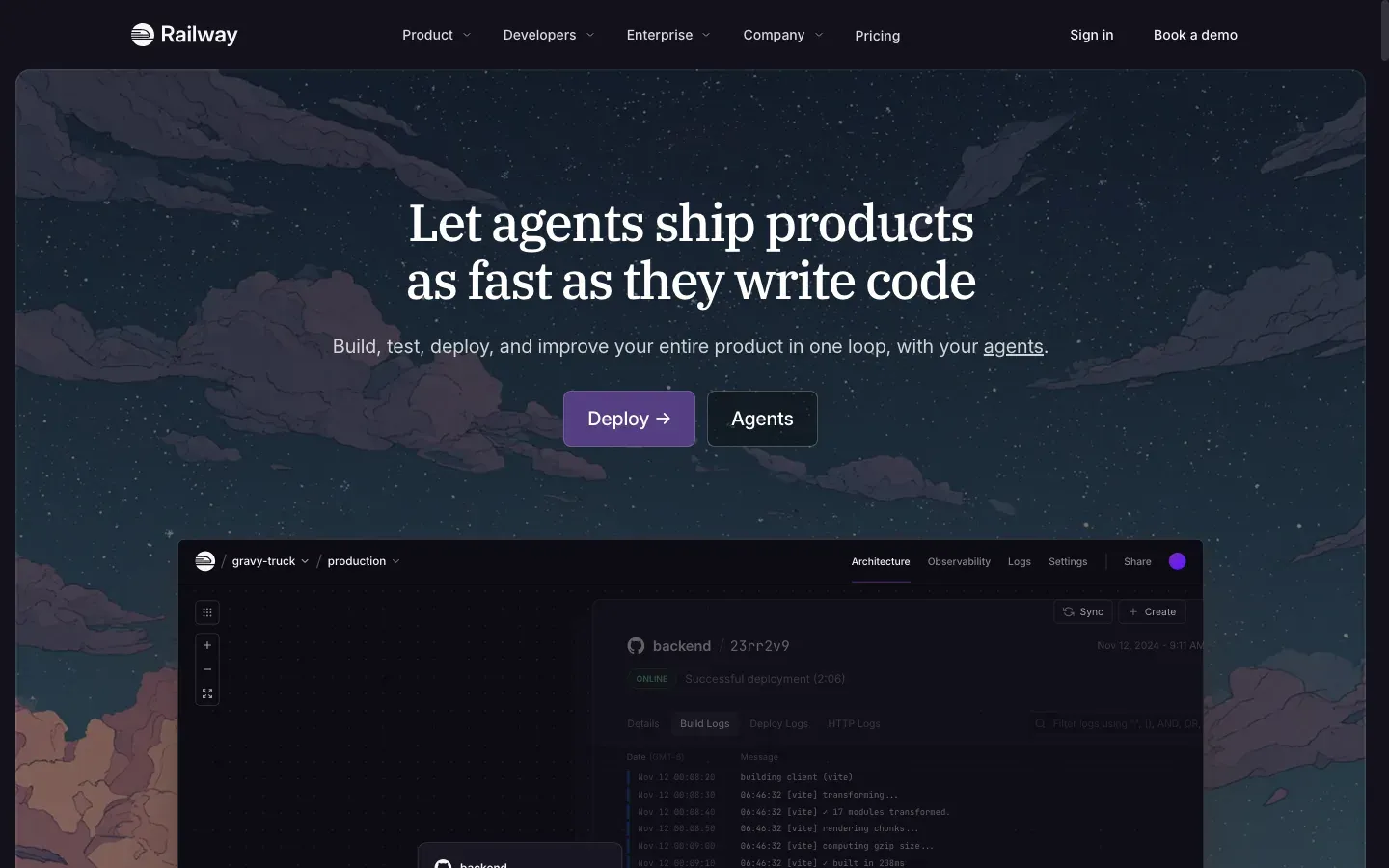
Every developer knows the sentence: “it works on my machine.” It’s true, and it helps nobody. The app runs on your laptop, someone asks if they can see it, and the less fun part begins: server, database, domain, environment variables, certificate. Railway exists for that part.
This is the Railway referral link: according to its affiliate program page, people who sign up through it get $20 in credits, which it says equals a free month on the Pro plan. It’s for anyone who wants to ship an app, an API or a bot without building a server from scratch.
(Yes, it’s a referral link: Railway pays me 15% of what you spend in your first 12 months. It doesn’t cost you anything extra, and the credits are yours. Disclosure first, link second.)
Below you’ll find what Railway does, what it costs, a sample bill and the question that matters: is it worth it? (Spoiler: depends on how long your app stays on.) Prices change, so check Railway’s page before you pay. Last updated November 18, 2026.
How to use the Railway link and get $20 in credits
- Open the referral link.
- Create your account. You can sign in with GitHub.
- Start with the 30-day trial, which doesn’t ask for a card.
- Check your balance under Billing.
One honest warning: the program page mentions the $20 but doesn’t say when the credit lands. A reply on Railway’s forum suggests it’s when the account moves to a paid plan. So check your balance after you sign up, before you count on it.
What Railway is
Railway is a deployment platform. You create a project, and the project holds services: a backend, a frontend, a database, a worker. Each service deploys from a GitHub repo or a Docker image. For repos, Railway analyzes the code and builds the image itself, and you can still override the build and start commands when the defaults don’t fit.
What comes in the box, according to the docs:
- Private networking. Services in the same project join a private network automatically, so your backend talks to the database without going over the public internet.
- Environments. You can keep production and staging inside the same project.
- Volumes. Persistent storage, with manual or scheduled backups.
- Variables. Config and secrets per service, with references to share values between services.
- Domains. An address generated by Railway, or your own.
- Metrics. CPU, memory and network for each service, in charts.
Databases such as Postgres and Redis join the project as one more service, from templates. Instead of configuring everything, you click and move on.
How to deploy an app in a few steps
- Create a new project.
- Pick the GitHub repo and the branch.
- Wait for the build and the deploy.
- Generate a domain in the service’s networking tab.
- Add your variables and, if you need one, a database.
Five steps, and not one conversation about SSH. Thanks, Railway, for making the side-project weekend slightly less painful.
How I use Railway
I use Railway to host Aptabase, a privacy-first usage tracker, for my apps. It works amazingly well. It’s a service that runs all day, takes in events from the apps and stores them without making me spy on anybody, exactly the kind of chore I don’t want to babysit. A tracker that doesn’t watch users, running on a server I don’t have to watch either. Symmetry.
How much Railway costs
According to the pricing page, these are the plans:
| Plan | Price | Included usage | Main limits |
|---|---|---|---|
| Trial | Free, 30 days | $5 one time | 2 projects, 5 services, 1 GB per service, no card |
| Free | Free | $1 a month | 1 project, 3 services, 0.5 GB per service, services sleep without traffic |
| Hobby | $5/month | $5 a month | 50 projects, up to 48 GB per service, 5 GB volume, 2 domains |
| Pro | $20/month per workspace | $20 a month | 100 projects, unlimited seats, 1 TB volume, 20 domains |
| Enterprise | Custom | Custom | SLA, SSO and dedicated support |
Past the included usage, billing is per second, based on what your service consumes:
| Resource | Rate | Approx. per month |
|---|---|---|
| Memory | $0.00000386 per GB/s | $10 per GB |
| CPU | $0.00000772 per vCPU/s | $20 per vCPU |
| Volumes | $0.00000006 per GB/s | $0.15 per GB |
| Egress | $0.05 per GB | |
| Object storage | $0.015 per GB-month | Free egress |
A sample bill
At the rates above, a small app with 0.5 GB of memory and an average of 0.1 vCPU, running all month, comes to around $7: $5 for memory and $2 for CPU. That’s my estimate from the published prices, not an invoice. Traffic and a database add to it.
The point is that Railway bills what you use, not what you reserved. An app that sits idle most of the time costs little. An app running flat out costs what you’d expect. Thanks, per-second billing, for reminding me that an idle server still has a cost.
One more thing for Brazil: you pay in dollars. On an international card, the exchange rate and the IOF tax apply, so the bill in reais comes out a bit higher than the pricing page suggests.
The catches
Read this before you pay:
- The trial ends. When the 30 days or the $5 run out, running deployments stop. You can drop to the Free plan and redeploy within its limits, or subscribe.
- Free sleeps. After 5 to 10 minutes without outbound traffic, the service goes to sleep. Fine for learning, not for a site that has to answer right away.
- Hobby doesn’t roll over. Included usage you don’t spend doesn’t carry into the next month.
- No refund policy is listed. The pricing page doesn’t mention one. When you cancel Hobby or Pro, the plan stays active through the end of the cycle, and usage is charged at the end of the period.
- Downgrades wait. Upgrades apply right away, downgrades at the start of the next cycle.
Is Railway worth it? Who it makes sense for
It does for me. It makes sense if you run small or mid-size projects and would rather spend your time on the product than on the server: weekend apps, APIs, bots, prototypes, backends for mobile apps. Hobby at $5 covers a lot of that, and the trial lets you find out without a card.
It makes less sense if your app needs a fixed, predictable cost, or if you already have infrastructure up and running. Usage billing is great until the day a buggy service decides to eat memory like there’s no tomorrow. Set spending limits and keep an eye on the dashboard. Who hasn’t left a server running by accident, right?
If it fits, the link is right here: Railway referral link.
Sources
The data comes from Railway’s own pages, read on November 18, 2026: the pricing page, the affiliate program page and the docs. The cost example is my own estimate. Prices, limits and promotions change, so Railway has the final word.